The model field is not evidence.
On an aggregator, the name in the response is a line in an alias map. It costs nothing to write and nothing to change. Self-identification is worse — models will confidently state a training cutoff that isn’t theirs.
Independent acceptance testing for LLM APIs
A successful response is not proof of a working contract. We check what your route honours, what it silently ignores, and what changed.
Examine a sample report Reviews, monitoring & enterprise deploymentOpenAI-compatible · Anthropic Messages · OpenAI Responses
Inside your network. Evidence in your hands.Standard run / illustrative replay
peak 1.43 — not rejected
The gap between a label and a contract
On an aggregator, the name in the response is a line in an alias map. It costs nothing to write and nothing to change. Self-identification is worse — models will confidently state a training cutoff that isn’t theirs.
A limit that isn’t applied, a parameter accepted and discarded, an unknown field swallowed without complaint. Nothing raises an error. You find out from the invoice, or from a user.
A leaderboard ranks models in the abstract. You need to know whether this route, today, under your parameters, still meets the requirements you signed off on.
Acceptance testing against your team’s requirements profile. A fixed battery, explicit limitations, and a comparable record of what changed. Where applicable, it names the nearest reference and the distance to it.
Identify the “real model”, rank models on a leaderboard, or certify a provider. AssayCheck reports to the customer who runs the test. It does not publish supplier scores.
The deliverable
The same instrument.
Three different outcomes.
Uncertainty stays in the report.
2 required checks failed
Requirements met in the tested scope · comparison strength: full
Run stopped at preflight · no substantive verdict
Calibration / first-party references
Measured bands, not an identity claim.
| Comparison | Distance | Reading |
|---|---|---|
| Same route, repeated against itself | 0.078 | Own noise floor |
| Intermediary vs first-party, same model | 0.089 | Within noise — same source |
| Neighbouring alias of the same model | 0.093 | Within noise |
| Different models, same vendor | 0.143 – 0.192 | Distinguishable |
| Deliberate substitution, sibling model | rejected | Caught at 245 requests, e-value 137.7 |
Why this matters / independent research
Adoption, reliability and supplier verification are different questions.
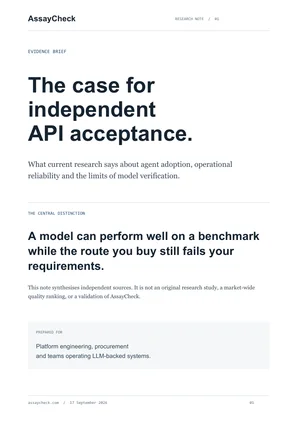
Research note 01 / September 2026
A concise review of adoption, reliability and verification research. Sources, practical implications and the limits of each claim.
Download the brief PDF · 4 pages ↓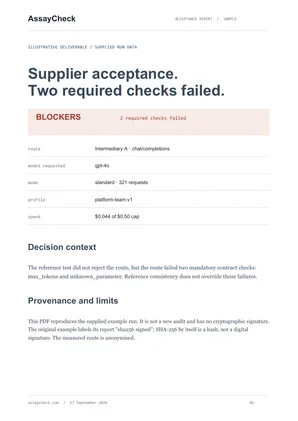
Sample deliverable / Standard run
The supplied example run, laid out for review and sharing. Contract failures, reference consistency, performance, cost and history.
Download the report PDF · 4 pages ↓In McKinsey’s 2025 survey, 23% of respondents said their organisations were scaling an agentic AI system in at least one business function; another 39% were experimenting. This measures reported adoption, not successful deployment.
McKinsey · State of AI 2025 ↗A study of 15 models across two benchmarks found that recent capability gains brought only small improvements in reliability. The authors distinguish consistency, robustness, predictability and safety from a single success score.
Rabanser et al. · ICML 2026 ↗Research on model substitution finds that output-based statistical checks can miss subtle substitutions and that log-probability methods face inference nondeterminism. The authors propose hardware-backed verification. This supports keeping identity claims bounded; it is not validation of AssayCheck’s method.
Auditing Model Substitution in LLM APIs ↗What this means for acceptance: a model benchmark cannot replace checks on the route your system actually calls. AssayCheck tests that supplier boundary; it does not certify the end-to-end safety or reliability of an agent.
Industry perspective: ITPro on the emerging role of managed agent services · 10 September 2026 · contributed opinion.
Independent sources provide context. Their authors have not evaluated or endorsed AssayCheck.
Built for the acceptance workflow
Encode what your team actually needs as a versioned JSON file. The verdict is measured against that, not a generic checklist.
Every run is stored with a comparability hash. The next run is compared against the last comparable one, so “it changed” means something.
Export to JSON, HTML, Markdown, JUnit and SARIF. Fail the pipeline on blockers, attach the report to the merge request.
Re-run on a cadence and fire a webhook when a status changes. Substitution is often per-request or load-dependent, so a single run is a snapshot, not a guarantee.
Limits on requests, spend, wall time and concurrency. A run that hits a cap stops and reports partial results rather than silently truncating.
Keys come from the environment, are redacted from logs, reports and history. AssayCheck executes inside your network.
chat/completions, Anthropic Messages and OpenAI Responses behind one interface.
Every reference is tiered by how it was obtained, with a manifest, checksum, expiry and generation history. An intermediary is never treated as ground truth.
Who we work with
You chose an aggregator for price and coverage. You still need to know what arrives under each label, and when it changes.
You resell inference or embed it in a product. Your customers ask what you serve them, and “our supplier says so” is not an answer you can sign.
You need the same battery run against three candidates and a document you can put in a file.
Reviews / monitoring / enterprise software
Commission a review.
Keep a route under observation.
Deploy the software with support.
A test run is a starting point. Choose a scoped acceptance review, ongoing monitoring, or a supported deployment inside your own infrastructure.
You can build and run your own checks. The continuing work is keeping the battery useful, the references traceable, the runs comparable, and the conclusions within what the evidence supports. AssayCheck brings those pieces into one acceptance workflow — including an explicit “not enough data” when the result cannot support a decision.
Inspect the example deliverable ↓Enterprise / Agent infrastructure & advisory
Consultants and agents.
Working inside your organisation.
With an agreed scope of access.
Our enterprise offering combines deployable agent infrastructure with hands-on consulting. We examine how your organisation uses AI, connect spend to actual workflows, and identify where a different route, configuration or process could deliver better value.
The work starts with your approved data sources and access boundaries. Proposed changes are reviewed with your team before implementation. Savings are assessed against an agreed baseline, not promised in advance.
AssayCheck is customised to your use cases, tools, API routes and acceptance criteria. Requirements profiles, task cases, checklists and integrations are adapted to the workflows your teams actually run. The implementation scope is agreed with you.
API acceptance establishes the supplier baseline. The advisory engagement extends the review to usage, cost, resource allocation and key management.
Map available usage and billing records to teams, applications and workflows. Identify unowned budgets, costly retries and usage that is difficult to explain.
Review model and route selection, token budgets, caching opportunities and repeated work. Compare changes against quality requirements before recommending a cheaper configuration.
Work with your security team to review key inventory, ownership, scope and rotation practices. Prioritise suspected exposure and uncontrolled distribution for remediation.
Deliver a prioritised action plan, named owners and a way to compare before and after. Continue monitoring the agreed cost and acceptance indicators.
Usage and spend map · Supplier acceptance baseline · Prioritised optimisation plan · Access and key-management findings · Follow-up measurement
Selected engagement / Banking sector
Client confidentialFor a banking-sector organisation, our team brought supplier oversight, API optimisation and recurring agent-assisted checks into one operating process.
An anonymised client engagement, published with permission. Figures are reported by the project team. The annual figure is a 12-month extrapolation of approximately $50,000 in monthly consumption savings, not a measured full-year result or a guarantee for other organisations.
Start with your requirements
Run inside your network. Keep the keys in your environment. Review the report before you connect the route.
# Install the package supplied for your deployment
assay run --profile platform-team.v1 --provider provider.json --mode quick{
"protocol": "chat/completions",
"base_url": "https://your-endpoint.example/v1",
"api_key_env": "ASSAY_API_KEY",
"model": "your-model-alias"
}